





Arrested for DUI in Florida? Here’s What Happens in Your First 10 Days
You didn’t see this coming. Maybe you had a couple of drinks at dinner and felt fine, then saw the lights in your mirror. Maybe it was a checkpoint on the causeway. Either way, once those handcuffs go on, a clock starts running. Most people don’t know what that clock means, or what happens if it runs out.
You can’t just wait this out. Florida DUI law moves fast, and since October 2025, refusing a breath test got a lot more serious too. What you do in the next 10 days can affect your license, your case, and your record for years.
The 10-Day Clock Almost Nobody Explains Properly
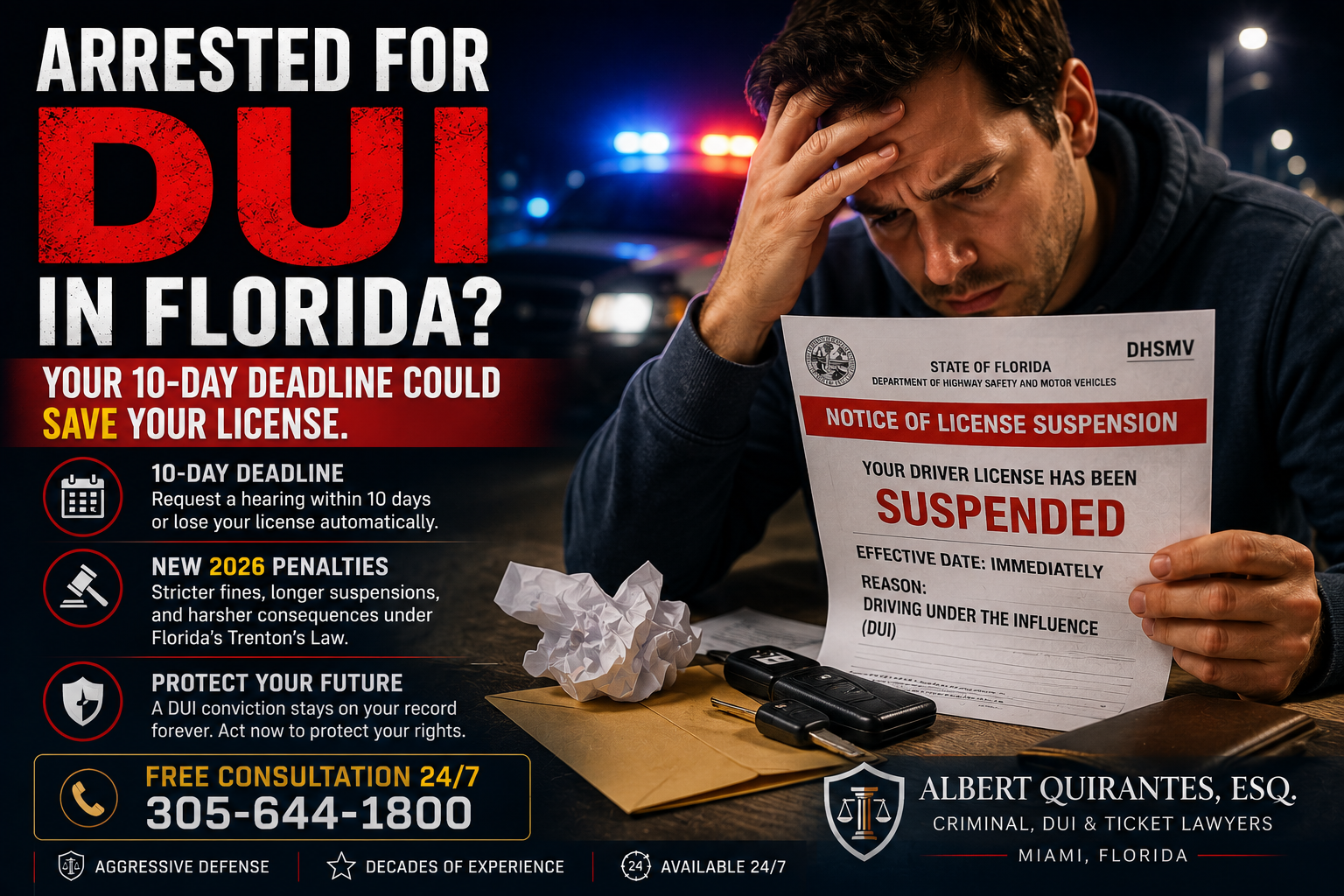
When police arrest you for DUI in Florida, they take your license right there on the roadside. In its place, you get a notice of suspension that also works as a 10-day temporary permit. That paper matters more than it looks like it does.
Under Florida Statute 322.2615, you have 10 calendar days from your arrest to request a formal review hearing with the Department of Highway Safety and Motor Vehicles, or DHSMV. This is separate from your criminal case. It’s a civil, administrative process. Miss the deadline, and your license suspension kicks in automatically, no matter what happens later in criminal court.
Request the hearing on time and DHSMV has 30 days to schedule it. If they miss that deadline, the suspension gets thrown out. If your hearing gets pushed back for reasons on their end, you can get a temporary permit good until the hearing actually happens, though it only covers driving for work.
Here’s what you’re up against if that 10-day window closes:
- First DUI, BAC 0.08 or higher: 6-month suspension
- Second or later DUI, BAC 0.08 or higher: 12-month suspension
- First refusal to test: 1-year suspension
- Second or later refusal: 18-month suspension
None of that depends on a conviction. That’s the part people miss.
What You’re Actually Facing: Florida DUI Penalties in 2026
Florida sets DUI penalties based on your BAC, whether you’ve been convicted before, and whether anyone got hurt. For a standard first offense with no aggravating factors, under Florida Statute 316.193, here’s what you’re looking at:
- A fine between $500 and $1,000
- Up to 6 months in jail (rare for a first offense, but it’s legally possible)
- Up to a year of probation
- 50 hours of community service, unless the court finds hardship
- Mandatory DUI school with a substance abuse evaluation
- License suspension of 180 days to a year
- 10 days of vehicle impoundment
- An ignition interlock device, if the judge decides to order one
If your BAC was 0.15 or higher, or you had a minor in the car, the penalties go up. But not the way a lot of articles describe it. They don’t just double. The fine range moves to $1,000 to $2,000, jail exposure goes up to 9 months, and the ignition interlock stops being optional. At that point it’s mandatory for at least 6 months.
A second DUI within 5 years comes with a mandatory minimum of 10 days in jail. No exceptions. A third DUI within 10 years is a third-degree felony, with a mandatory minimum of 30 days in jail and a 10-year license revocation.
And that’s just the court side. Higher insurance rates, trouble with professional licensing boards, immigration consequences if you’re not a citizen. Those costs show up quietly and stick around a lot longer than the case does.
Trenton’s Law Changed the Rules on October 1, 2025
If you were arrested on or after October 1, 2025, a different law applies to you than the one most websites are still writing about. House Bill 687, known as Trenton’s Law, made refusing a breath, blood, or urine test a crime in Florida. Before this, refusal only meant a license suspension.
First refusal, under the new rules:
- Second-degree misdemeanor
- Up to 60 days in jail
- Up to $500 in fines
- Plus the usual 1-year license suspension
Second or later refusal:
- First-degree misdemeanor
- Up to 1 year in jail
- Up to $1,000 in fines
- Plus an 18-month license suspension
Officers now have to tell you that refusal itself is a crime, separate from the suspension. And your refusal can be used against you at trial. Under Florida Statute 316.1939, prosecutors can tell the jury you refused and argue it shows guilt.
Trenton’s Law also raised the penalty for repeat DUI manslaughter convictions. A second or later conviction is now a first-degree felony, up to 30 years (it was 15), with a mandatory minimum of 4 years.
This law only applies going forward. If your arrest happened before October 1, 2025, the old rules still control your case. If it happened after, you’re facing a separate criminal charge just for the refusal, and that changes how your defense needs to be built from day one.
5 Mistakes That Turn a Defensible DUI Into a Conviction
- Missing the 10-day DHSMV deadline. Once it’s gone, you’ve lost your shot at fighting the suspension before your criminal case even gets going.
- Assuming you have to plead guilty. Breathalyzer calibration problems, bad stops, sloppy field sobriety tests. These come up more than people think.
- Talking to police without a lawyer. Whatever you say gets used against you. Ask for your attorney and stop there.
- Posting about the arrest online. Don’t. Not a vague update, not a joke, nothing. Prosecutors check social media.
- Waiting to call an attorney. Dashcam footage gets recorded over. Witnesses forget things. The sooner your attorney gets involved, the more they have to work with.
Can a Florida DUI Be Reduced or Dismissed?
More often than people expect. Prosecutors and judges see DUI cases constantly. What they see less often is a defense attorney who’s actually dug into the specifics of the case in front of them.
Grounds for a reduction or dismissal show up in a few common places: a traffic stop that lacked reasonable suspicion, a breathalyzer that wasn’t calibrated or maintained properly, field sobriety tests run by an officer who wasn’t trained correctly, or a medical condition (acid reflux, diabetes, certain medications) that can throw off a BAC reading.
A reduction from DUI to reckless driving, under Florida Statute 316.192, is often called a “wet reckless.” It comes with no mandatory DUI school, lower fines, and it doesn’t set you up for felony exposure down the road. Here’s where people get confused: Florida law requires a formal conviction on any actual DUI, under Florida Statute 316.656, and that locks it out of ever being sealed or expunged. Doesn’t matter how well you handle probation. A reckless driving reduction is different, because adjudication can be withheld on that charge. If it is, you may be able to petition to seal the record later. That’s not automatic, and it’s not the same as walking away with a clean record, but it’s a real difference from a DUI conviction, and it’s something experienced attorneys negotiate all the time.
What Happens Next: First Appearance in Miami-Dade
After the arrest, you’ll get a court date. In Miami-Dade, first appearance and bond hearings move fast. The State Attorney’s Office reviews the evidence and decides whether to file formal charges. During this window, your attorney’s job is to get the full evidence file, find the weak points in the state’s case early, and put you in the best position before things move further along.
Don’t show up to court alone. Don’t take a plea deal at first appearance without a lawyer. And don’t assume your case doesn’t matter just because DUI arrests happen all the time. Florida prosecutors take these seriously, especially under the current law.
Frequently Asked Questions
How many days do I have to save my license after a Florida DUI arrest?
Ans: Ten calendar days from the date of arrest to request a formal review hearing with the DHSMV under Florida Statute 322.2615. Miss it, and the suspension becomes automatic no matter how your criminal case turns out.
Is refusing the breathalyzer a good idea in Florida now?
Ans: Not without understanding the current law. Since Trenton’s Law took effect on October 1, 2025, a first refusal is a criminal charge, up to 60 days in jail and a $500 fine, on top of the 1-year license suspension. Before this law, refusal only meant a suspension.
Can a first-time DUI in Florida be expunged or sealed?
Ans: No. Florida law requires a formal conviction on any DUI, which locks it out of sealing or expungement permanently. A reduction to reckless driving with withheld adjudication may qualify for sealing later. A DUI conviction itself never does.
Will I automatically go to jail for a first DUI in Miami?
Ans: No. Jail time isn’t mandatory for a standard first offense. It’s legally possible (up to 6 months, or up to 9 with a BAC of 0.15 or higher or a minor passenger), but a lot of first-time offenders get probation instead. Case specifics and legal representation make the difference.
What’s the difference between my DHSMV case and my criminal case?
Ans: Two separate proceedings. The DHSMV case is a civil review of your license suspension. The criminal case is prosecuted by the State Attorney and decides guilt, penalties, and your record. Winning one doesn’t automatically resolve the other.
What is a “wet reckless”?
Ans: A plea reduction from DUI to reckless driving under Florida Statute 316.192. It carries lighter penalties than a DUI conviction, skips mandatory DUI school, and, unlike a DUI conviction, may later qualify for sealing if adjudication is withheld.
Call Now, Every Hour Counts
Your 10-day clock is already running. Albert Quirantes, Esq. has defended more than 8,000 cases in Miami-Dade, Broward, Palm Beach, and Monroe County courts over 35+ years, including DUI arrests under both the old rules and the new ones under Trenton’s Law.
Call (305) 644-1800 now for your free defense strategy session. Available 24/7. Learn more about our DUI defense representation or visit Albert Quirantes, Esq. Criminal DUI & Ticket Lawyers.
Albert Quirantes, Esq. has practiced criminal defense in Miami-Dade courts for more than 35 years and has handled more than 8,000 cases, including DUI defense, felony defense, and bond hearings. Licensed by the Florida Bar, Bar No. 750270.